skip to main |
skip to sidebar
"Choose not to be harmed, and you won't feel harmed. Don't feel harmed, and you haven't been."
--Marcus Aurelius
I had to read and meditate on the famous stoic Marcus Aurelius's wisdom for quite a while to sort out his thinking and how I could apply it to my life. It came to me slowly what he was driving at. It was the principle of taking everything personally while at the same time looking at what is said or done to you as a positive opportunity.
Yes, everything good or bad is a positive growth opportunity.
After all, if you allow someone or something to make you angry, sad or worried, you have taken what you can control and gave the power to them. Transferred your personal agency to another. Sure, it feels good to yell at the person that cut you off in traffic, be angry at the baby crying in the restaurant or just saddened by hurtful words. Maybe this is the opportunity to look at our reactions, confront our feelings, and look at them in a new, less-painful light.
First, I would challenge us to put ourselves in the other person's shoes. I know that most of us have probably heard this a thousand times before, but if you are anything like me, it doesn't seem to stick very well, like worn out Velcro. I've taken to grabbing one of three words to apply to stuff like this: where, when or why.
I would apply any one of these three words to any of the previous examples. Applying my logic to someone who has said something hurtful to me, I would ask the 'Where' verb of myself: "Where does that person want this to go?'; "Where did they learn to act like this?"; or, "Where inside themselves are they suffering?"
Or you could choose 'When.' "When were they hurt?"
And lastly, "What can I do about it so that I don't suffer?"
Doing this for myself has been a rich experience, and it has been an opportunity for me to grow as a person, and be much, much more empathetic with others. I also have come to think of where what, and when as three basic questions that can help in the understanding of people and what has shaped them, drives them and ultimately leads to the greater reflective observation of their unique, troubled, challenging, wonderful, varied story.
Maybe that crying baby will grow up to be a doctor that will help cure a cancer, that person who cut you off was rushing to a hospice to say goodbye to a dying relative, or the person saying hurtful things may be expressing unconscious expressions of the hurt that was visited on them that they may not understand.
"On my cornice linger the ripe black grapes ungathered;
Children fill the groves with the echoes of their glee,
Gathering tawny chestnuts, and shouting when beside them
Drops the heavy fruit of the tall black-walnut tree."
--William C. Bryant
I had to ride my bike down the road past his house to get to my friends house. It was the only route available. Four years older than me, he had salt and pepper hair before he even graduated high school. I suspected he would wait for me to ride by, and then throw the walnuts that fell from the tree in his front yard. At me on my bike. Black walnuts when they were still heavy and green. The longer those walnuts aged upon the ground, their outer husk starting to decompose, the more they stained and smelled when they painfully hit you. Exploding black and green and slimy. Sometimes his friends joined him in this pastime. He and his friends subsequently called me "walnut man" due to this exercise.
I now have a walnut tree in my front yard, and I still can smell that sting of those walnuts all these years away when I pick them from the grass beneath the tree.
He is a jail administrator in a northern Michigan county now, according to my mom.
"He was a nice boy", she told me over the phone.
"What's done to children, they will do to
society." -- Karl A. Menninger
There seems to be an awful lot of attention these days to what can only be categorized as awful things that adults do to children. In Hollywood, in the legal system, in our public schools, or just about anywhere adults have the opportunity to interact privately with children, we are beginning to hear about the abuse and intimidation and betrayal that are occurring. These places and situations where our young people are being harmed are starting to be dragged from the darkness into the bright light of the truth, a truth that is very, very disturbing. More and more the despicable people that prey on children are losing their safe havens, and as Goethe said, "The coward only threatens when he is safe."
I suggest offering them no amount of safety.
The sad realization to me however, is that we seem to be failing our children. We need to instill a sense of a higher expectation of love in our households, in our schools, and in our communities, while at the same time helping our young people to expect and demand that from other people. Society should be demanding that adults behave like adults, the kind of adults who love children. This has to be an important priority.
I have the tendency to believe that most people are good, and that leads me to trust more than I probably should. It is more likely that most of us are good, and harming children or any person is not what we are about. But by believing this, have I somehow been careless with providing tools to help children understand how they should be treated? Have I placed those in my care at risk?
I don't know. And that is my shame.
"If taxation without consent is robbery, the United States government has never had, has not now, and is never likely to have, a single honest dollar in its treasury. If taxation without consent is not robbery, then any band of robbers have only to declare themselves a government, and all their robberies are legalized." -- Lysander Spooner
Have you ever truly had a piece of postal mail ruin a perfectly nice trip from your mailbox?
Here is my story of just such a ruined journey.
Once upon a time (as all good stories should start), my wonderful Mother-In-Law recently gave my wife and I a car. Gifted. Doué. Free. Gratis.
So I dutifully checked the box on the title indicating that it was a gift from a family member and transferred the title, registered the vehicle and called it good.
Nope. Nada.
Here comes the mailbox part of the story.
I received a letter from the State of Michigan, henceforth to be referred to as the "State", requesting documentation to support my claim of being related to my Mother-In-Law in order to take advantage of the tax free status of being gifted a vehicle. A rather threatening dispatch from the State with deadlines stating when to respond, penalties that would be levied, interest charges that I would incur and other overt hazards I would face if I just ignored this letter. It seems that this was an important and urgent matter that the State required me to explore. In depth. With official supporting documents. All bold faced and italicized within the letter.
Enter rage.
It truly ruined a perfectly nice trip to my mailbox.
As I had previously checked the box on the Application for Title regarding this, with the stated penalty for falsifying this stated clearly, and I quote: “Any alteration, erasure, false statement, forgery or fraud voids this title and is a crime”, I was left scratching my head for the duplicity this letter was requiring of me to do. I take seriously the process of placing my signature on documents. Especially after such threats worth repeating here like “Any alteration, erasure, false statement, forgery or fraud voids this title and is a crime” are part of the “contract” between me and the State. After all, I was only asking for the clearly stated particular tax exempt transfer benefit that I was entitled to.
But my signature was not enough this time. My honor was not to be believed or trusted. Especially if it meant that the State would be missing out on grabbing any of my hard-earned tax dollars that it felt that it might be owed.
In fact, on review of the “Letter of Inquiry Concerning Michigan Taxes,” it supports the fact that:
- The State does not trust me.
- The State has people, namely a Mr. “Brian,” whose sole purpose is working to extort possible additional tax dollars, working in a job funded by tax dollars, in a office building paid for by citizen's flesh and blood efforts, all of which seem to be being wasted on me in this instance.
- The State wastes postage to mail out letters to honest law-abiding citizens such as myself to extort said tax dollars.
- The State wastes resources in its effort to extort tax dollars in the form of purchasing envelopes, printing a letter, inserting it in that envelope and managing a database to question its citizen’s integrity and truthfulness.
- The State requires me to further use my personal resources such as time to search and find required documentation, dollars to reproduce documentation, postage to return said documentation and the personal aggravation of the whole process. This required my Senior Citizen Parent-In-Laws to go to a safety deposit box, procure and copy their marriage license, and finally mail it to me so I could place it alongside my wife’s birth certificate and our marriage license (which required me to go out and get copies made) to confirm the connection.
This “Letter of Inquiry Concerning Michigan Taxes,” more of a “Letter of Demand” in my view, required me to ask my senior citizen Parent-In-Laws to drive to a safety deposit box, procure and copy their marriage license, place it back into the safety deposit box and mail it to me. I could then place this documentation alongside my wife’s birth certificate and our marriage license (which required me to go out and get copies made) to confirm the family connection. And finally, mail it, at my cost for postage, back to the State.
All of which I did, being a good rule-following, boot-licker that I can sometimes be. To my own shame I should add.
Yet, I somehow feel as if the State of Michigan ought to be invoiced from me for the wasted time and resources that it took for me and my loved ones to respond to this “time suck.”
And also, TAXATION IS THEFT.
Note: I will henceforth carefully consider requests by my government for increased funding through tax dollars. I will lodge my final decision on these matters in the voting booth.
“No I do not like it, not one little bit.” – The fish from Dr. Seuss’s children book, The Cat in the Hat
Sometimes a cat in a hat is just a cat in a hat.
Yes, I understand that this might not fit into everyone’s little narrative statement, but it is true. I am troubled by the hypersensitivity that is causing people to over-analyze, over-react and even become anxious and depressed over perceived discriminatory objects. Or by being scared, worried or upset over what someone else might be going to do, like the children's red fish from the "The Cat in the Hat" story.
Are we capable of stopping ourselves from doing this? I believe we are. I always try to remind myself that I cannot control what other people say or do. That’s right, I don’t have that superpower. Nor do I want it, or want others to have it. That is one of the great tenets of the United States Constitution under the 1st Amendment’s protection of freedom of speech. You just can’t enforce laws that work at “prohibiting the free exercise thereof; or abridging the freedom of speech”.
This post would be an example. I guarantee that there are people out there that will read this, disagree with this, and get all butt-hurt by this post. That’s fine with me. If you want to give your power to be happy to me, the writer of this post, or to some other idiot waving a flag you don’t like, or your child reading a book you find offensive or watching someone else eating something not “produced” the way you believe to be proper, go for it.
But there might be another way to help so you don’t forfeit your mental health in your quest to make everyone agree with your opinion and viewpoint.
Try to limit your interactions with those things that make your heart race with excited agitation, your skin break out in an anxious sweat and your body start to tremble with disgust. Do what you do when you hear a song on the radio you might not like, a Milli Vanilli song for an example from my taste in music: turn the radio dial to the off position, choose another radio station or temporarily turn down the volume.
Now I want to assure you that this is in no way an effort to be naïve about critical social issues, it is just a way to build emotional and cognitive buffers so you do not suffer from the ignorance and insensitivity of some people.
And then and only then, it might be easier to believe that a cat in a hat is just that.
 “Sometimes it is better not to talk. At all. About anything. To anyone.” – Unknown
I escaped to the river for a few short hours on a sunny afternoon. Took my kayak and my fishing gear to a spot I could briefly paddle upstream to and try to attempt to catch a few fish. But when I look back at the experience now, it wasn’t about fishing at all. It was the silence of fishing that I was seeking.
Everything around me of late has seemed so challenging. Some of the challenges are quite correctly of my own making, as I tend to take the world a bit seriously these days. My seriousness tends to boil inside of me as silence, seeking all the time to try to act on, or say something, that is better than the silence. I remember telling myself once that a wise, peaceful and compassionate person needs to be found alone at times, saying nothing, listening to no other human voices. Silent. Quiet. Still. No words in books, no music from the radio, no actors or anchors on the TV, no endless knowledge of the internet, no people talking.
So what I came away from the river with was lungs filled with moist river air, that was fragrant with late summer flowers. I came away with gently rippling sounds inside my head of the water flowing over rocks, tumbling over wind-fallen trees and the splashing of the paddles urging me upriver. I came away with eyes filled with turtles sunning on the floating logs, sparkling fish, cedar waxwings dancing through the branches, an osprey hunting above me and green shades of late summer as far up and down the river as I could see.
Surrounded as I was with the quiet of nature, I barely knew what was transforming inside me. The quieter I became, distanced from the civilized world’s noise, the more I began to hear.
What I heard, but did not recognize till later was that I may not be perfect, the world is certainly imperfect, but watch us both improve. As time passes, I realize how much I have improved as a person. I look at the long recorded history of the world, one that is filled with great discoveries and great tragedies, but it has improved.
So what did I really go out to do that sunny summer afternoon? I went to find hope, and to continue when appropriate, to remain silent when those around me expect me to be enraged.
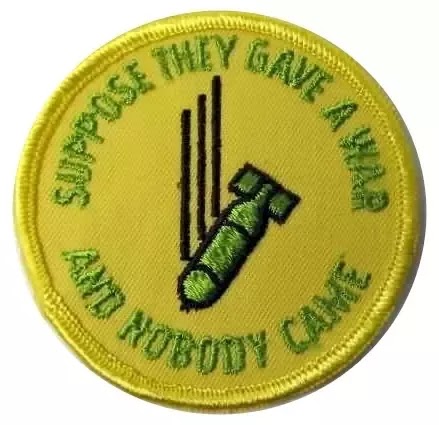
"Sometime they’ll give a war and nobody will come."-- Carl Sandburg
Racists. White supremacists. Anti fa. Communists. Black separatists. Anti-Muslim. Socialists. Neo-Nazis. Republicans. Democrats. Black Panthers. Black Lives Matter. KKK. LGBTQ (Add more letters as applicable).
Imagine if you had a group of white supremacists and neo-nazis or any other group standing around a statue of a figure from the southern side of the American Civil War. Imagine they are chanting hate-speech or other offensive things to the area surrounding this statue. Imagine they are dressed in attire that reflects their stance, brandishing signs with offensive slogans and are waving flags of a racist and offensive matter.
Are you mad yet? Then their tactics worked. And the human species suffered because of it.
Time for a brief disclaimer: I am for free speech. I will defend your right to it. Offensive speech generally turns me off from that speakers perspective. As Evelyn Beatrice Hall said (though this is often attributed to Voltaire): I disapprove of what you say, but I will defend to the death your right to say it.
Why engage these people at all? Why not ignore them? Do we need to know that when a tree falls in the forest it makes a noise, or if bears shit in the woods? Or if someone is spouting hate speech that there is anyone to hear it? What these groups do when they are engaged is turn their opposition into the aggressor, when they are the ones that are usually the lovers of peace.
Did the likes of Gandhi, the Dali Llama and Martin Luther King not teach people anything?
So many questions.
I would offer this to ponder about. Suppose you consider that before man existed, conflict waited. The ultimate practice of conflict awaiting man, the ultimate practitioner of conflict. Now apply it to current events of violent nature that all to frequently abound in the world.
Then throw in a televised news feed and some talking heads to fuel the fire.
Recipe for Charlottesville.




 Posts
Posts


